1

Social Forces in England and America — Key Ideas to Explore
6
2
Project Gutenberg
2020
Social problems; United States -- Social conditions -- 1865-1918; England -- Social conditions -- 20th century
Readers of public-domain and historical texts
Project Gutenberg digital edition
en
Edition facts
Words: 105,228
Reading time: 458 min
Text sections: 33
Source:
Project Gutenberg record #64186
H. G. Wells's 1914 essay collection examines social and political forces in England and America through topics from aviation to utopian thought, with a distinctive voice that blends analysis, polemic, and personal reflection.
Editorial Edition Score
4.9/5
★★★★★
★★★★★
Calculated from edition completeness, EPUB availability, text structure and catalogue metadata. Not a user rating.
Edition quality
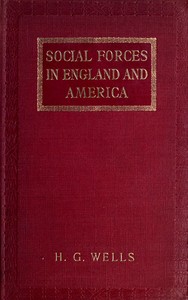
The table of contents of Social Forces in England and America reads like a fever chart of early twentieth-century concerns: Blériot's flight, labour unrest, the modern novel, the endowment of motherhood, and the possibility of civilisational collapse. Wells moves from the specific—a first flight, a new reign—to the sweeping, and his synopsis frames the book as a single argumentative journey. The opening chapters ground the reader in concrete events: the arrival of Blériot prompts thoughts on cheap travel, and a flight becomes a vantage point for social speculation.
This is not a systematic treatise but a collection of linked essays, each tackling a distinct issue. Wells's voice is direct, often combative, and he does not hesitate to name opponents or advocate positions. The excerpts show him engaging with Chesterton, Belloc, and Sir Thomas More, using them as springboards for his own vision of a “Great State.” Readers should expect a work that is as much about the act of argument as about its subjects.
From Blériot to the Great State
The book's opening chapters establish a method: take a contemporary event—Blériot's cross-Channel flight, a new king's reign—and extract its social implications. Wells's synopsis summarises this progression: “Blériot arrives and sets him thinking. (1) He flies, (2) And deduces certain consequences of cheap travel.” The reader is invited to follow a mind that moves from observation to extrapolation. The early essays on “The Coming of Blériot” and “My First Flight” are not merely descriptive; they are arguments about how technology reshapes society. Wells treats aviation as a force that will compress distance and alter national boundaries, a theme that recurs in later discussions of empire and warfare.
This opening sequence also introduces Wells's rhetorical style: he uses personal experience as a launching point for generalisation. The “I” of the narrator is present, but it is a public, argumentative “I,” not a confessional one. The reader should note how Wells balances the particular and the universal, using a single flight to question the permanence of existing social structures.
Polemics and Utopian Arguments
Several chapters are direct engagements with other thinkers. In “About Chesterton and Belloc,” Wells challenges what he sees as their unhelpful criticism, writing that “purely unhelpful criticism isn’t enough from a man of his size.” He appeals to Chesterton's “sense of fair play,” demanding that critics offer constructive alternatives. This combative tone is characteristic: Wells is not content to refute; he insists on a positive program.
The essay on Sir Thomas More is more historical but equally argumentative. Wells presents More as a “symbol” of a particular temperament, noting that his Utopia gave the world “a noun and an adjective of abuse, ‘Utopian.’” He emphasises More's “incidental scepticism” beneath his conformity, a quality Wells clearly admires. The reader should watch how Wells uses historical figures as foils for his own ideas, and how his critiques often circle back to the need for a coherent social vision—what he elsewhere calls “the Great State.”
The Range of Topics and the Unifying Voice
The table of contents reveals an astonishing range: labour unrest, socialism, warfare, the novel, public libraries, divorce, schoolmasters, motherhood, doctors, specialisation, population, and the possibility of civilisational collapse. Each essay is self-contained, but together they form a mosaic of Wells's social thought. The synopsis presents them as a single argument: after diagnosing “the Political Disease of our Times,” Wells speculates on the future of American population, considers “a possible set-back to civilisation,” and ends with “The Human Adventure.”
What unifies these disparate topics is Wells's consistent voice: pragmatic, impatient with dogma, and convinced that human intelligence can reshape society. He is as willing to question the existence of sociology as he is to propose an ideal citizen. Readers should approach the book as a series of provocations, each essay building on the previous one, even when the subject changes abruptly. The cumulative effect is of a mind in motion, testing ideas against each other.
Evidence of Wells's Argumentative Tactics
The excerpts reveal several recurring tactics. One is the use of hypothetical or rhetorical questions: “which side is he on?” Wells demands clarity from his opponents. Another is the appeal to a shared standard of fairness, as when he challenges Chesterton to offer a utopia of his own. A third is the historical parallel: More's Utopia is used to frame contemporary debates about social organisation.
Wells also employs a distinctive blend of abstraction and concrete imagery. He writes of “dull, persistent, energetic, unscrupulous grabbers tempered only by the vulgar extravagance of their wives and sons”—a vivid phrase that pins an abstract critique to a recognisable social type. The reader should note how Wells moves between levels of generality, using specific examples to anchor his broader arguments. This technique makes the essays feel immediate even when the topics are large.
Because the excerpts are drawn from the opening and middle portions of the book, they show Wells at his most programmatic. Later chapters, such as “The Possible Collapse of Civilisation” and “The Human Adventure,” may shift tone or scope. Readers should treat the early essays as establishing a method and a set of concerns that later chapters will develop, challenge, or complicate. The book rewards attention to Wells's rhetorical moves as much as to his conclusions.
Reader reflection
How will you remember this book?
Save your reaction, strongest insight, and memorable passage.
Your progress
0
/
10
2
How did the book work for you overall?
3
How likely are you to recommend this book?
4
What was the reading difficulty like?
5
Would a second reading be valuable?
6
Was the book easy to understand?
7
Did the book offer a fresh perspective?
8
Which element worked best for you?
9
Which lesson or insight stayed with you?
10