1

The Industrial Condition of Women and Girls in Honolulu: A Social Study — Inside the Classic
3
2
Project Gutenberg
2019
Women -- Employment -- Hawaii -- Honolulu; Child labor -- Hawaii -- Honolulu; Honolulu (Hawaii) -- Social conditions
Readers of public-domain and historical texts
Project Gutenberg digital edition
en
Edition facts
Words: 31,062
Reading time: 136 min
Text sections: 22
Source:
Project Gutenberg record #60735
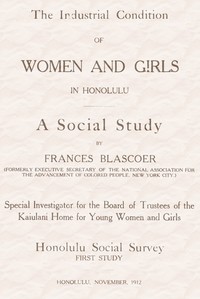
Frances Blascoer's 1912 survey examines wages, working conditions, and employment patterns for women and girls in Honolulu, drawing on employer interviews and verified salary data. The study reveals a labor market shaped by ethnicity, skill, and seasonal demand, with candid observations on native workers and the limits of reform.
Editorial Edition Score
4.7/5
★★★★★
★★★★★
Calculated from edition completeness, EPUB availability, text structure and catalogue metadata. Not a user rating.
Edition quality
Frances Blascoer opens her 1912 survey with a wry definition: a pessimist is one who has just met an optimist. This self-awareness colors the report that follows, which balances praise for Honolulu's favorable conditions—good air and light, no highspeed machinery, eight-hour days, paid vacations—with a clear-eyed account of wage disparities and skill shortages. Blascoer, formerly executive secretary of the NAACP, conducted the study under the Kaiulani Home for Girls board, making it the first volume of a five-part social survey. Her method relies on verified data: she lists sixty-nine salaries checked with both employers and employees, and reports on 110 responses from a circular sent to 250 households. The result is a document that is part advocacy, part statistical snapshot, and part ethnographic observation of a tropical labor market.
Diction and the Optimist's Warning
Blascoer's preface sets a distinctive tone. She calls the optimist-pessimist definition a warning that “floated warningly through my mind,” then confesses to a conviction that problems can be solved. This rhetorical move—acknowledging doubt while asserting hope—recurs in her descriptions. She notes that on kona days “all Honolulu wilts,” yet night brings relief, and that even the meanest tenement is swept by trade winds. The language is precise: “no highspeed machinery; no processes dangerous to life and limb are unguarded.” She avoids sentimentalizing the workers, instead using concrete terms like “self-trained” and “satisfactory if watched.” The voice is that of a social investigator who trusts data but knows her audience expects a story.
Wage Tables and the Shape of Inequality
Blascoer presents a salary list that ranges from $3.50 per week to $40.00, and monthly wages from $75 to $125. The distribution is uneven: most workers cluster between $8 and $15 weekly. She notes that the best-paid employees come from “the coast”—New York—while those earning $15 or less are Honolulans. Managers describe native girls as “desirable saleswomen” but lacking energy; one manager would hire more “if he could secure efficient ones, because of their amiability.” The report does not editorialize on these remarks, but the juxtaposition of wage data with ethnic commentary reveals a labor hierarchy. Blascoer also records that three shops give two weeks’ paid vacation, two give one week—a benefit she treats as noteworthy rather than standard.
Seamstresses and the Self-Trained Workforce
The investigation into seamstresses uncovered two facts: supply does not keep pace with demand, and most workers are self-trained. Of 110 households that replied, 78 employed a seamstress regularly, but more than half complained of incompetence or slowness. Blascoer quotes employers directly: “Satisfactory if watched”; “entirely untrained, though willing”; “competent for plain sewing and mending.” Only eleven seamstresses had served with dressmakers, and they were the best paid. The report implies that the lack of formal training depresses wages and quality, yet Blascoer does not propose a solution. Her evidence stops at the observation that the workforce is inadequate to demand, leaving readers to infer the structural gap.
Setting and the Limits of Tropical Ease
Blascoer repeatedly ties working conditions to Honolulu's physical environment. She writes that “the struggle for existence is not agonizing” in a tropical community, and that there is “no dread of the coming of winter.” Yet this benign setting does not erase low wages or ethnic stratification. The report notes that saleswomen are not required to wear black because of heat, and that new styles reach Honolulu “surprisingly quick” from New York. The detail about Chinese beginners of fifteen “who have here clothed herself in American garb” signals cultural assimilation as a visible marker of change. Blascoer's setting is not backdrop but argument: the climate enables certain conditions, but it does not determine fairness.
Blascoer's study is best read as a primary document of Progressive-era social investigation, not as a complete portrait of women's labor in Honolulu. The excerpts show a researcher attentive to numbers and to the words of employers and workers, but the full survey likely contains additional data on child labor, housing, and family budgets. Readers should note that the report was commissioned by a charitable board and reflects its reformist lens. The value lies in Blascoer's method—verified salaries, candid quotations, and a tone that wavers between optimism and critique.
Reader reflection
Your personal reading reflection
Build a private reading journal entry for this title.
Your progress
0
/
10
2
What was your overall reaction to the book?
3
Would you recommend this book to another reader?
4
How easy was the book to follow?
5
How strong was your personal connection to the text?
6
How would you rate its originality?
7
Do you expect to return to this book?
8
What was the strongest part of the book?
9
Which lesson or insight stayed with you?
10